The restructured program at Allens Lane Theater now stages one full play a year, with an emphasis on relevance to the Mt. Airy community. Last year’s offering, “Crossing Delancey,” by Susan Sandler, was a romantic comedy set in the Jewish Lower East Side. Allens Lane now takes you inside a black barbershop in the world premiere of “Don’t Sing No Blues For Me,” by Glenn Alan.
“Julie’s” is a barbershop in a small country town where black men discuss the sudden death of Ima Jean. They are shocked to learn that Ima Jean has a son named Choice, an incarcerated felon in …
This item is available in full to subscribers.
You can also purchase this individual item for $1.50
We have recently launched a new and improved website. To continue reading, you will need to either log into your subscriber account, or purchase a new subscription.
If you are a digital subscriber with an active subscription, then you already have an account here. Just reset your password if you've not yet logged in to your account on this new site.
If you are a current print subscriber, you can set up a free website account by clicking here.
Otherwise, click here to view your options for subscribing.
Please log in to continue |
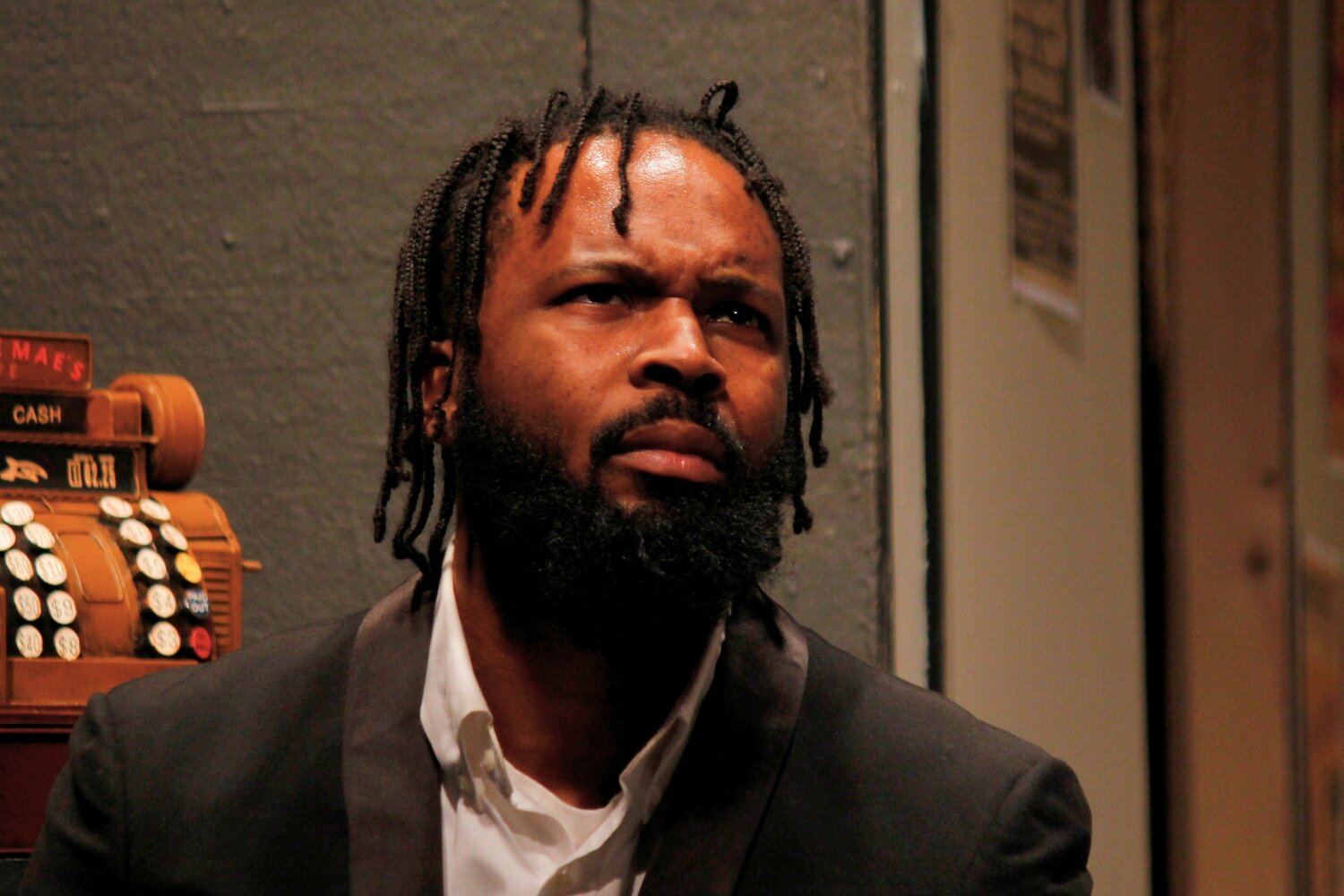


The restructured program at Allens Lane Theater now stages one full play a year, with an emphasis on relevance to the Mt. Airy community. Last year’s offering, “Crossing Delancey,” by Susan Sandler, was a romantic comedy set in the Jewish Lower East Side. Allens Lane now takes you inside a black barbershop in the world premiere of “Don’t Sing No Blues For Me,” by Glenn Alan.
“Julie’s” is a barbershop in a small country town where black men discuss the sudden death of Ima Jean. They are shocked to learn that Ima Jean has a son named Choice, an incarcerated felon in Chicago, who is permitted to attend the funeral. But who is the young man’s father? Mystery deepens into danger when they learn Choice has escaped the sheriff.
Alfred Lance, Jr. plays Max, the shop’s owner, a stout figure who exudes strength. His barbershop “Rules” like no cussing and no credit, are chalked on a blackboard by the wall telephone. You learn two things: keeping order in this community is an issue, and you do not cross Max. When problems arise, Max chalks up more rules, “No Personal Calls” and “Mind Your Own Business.”
Glenn Alan is the founder and driving force behind the DC Black Theatre & Arts Festival, now a premier stage for African American storytelling. In addition to impresario duties, Alan has written numerous plays, poems and short stories that explore the issue of black identity in America.
For that purpose, what setting can top the barbershop? Historically, a haven for black men, we meet an animated and zany collection of characters inside “Julie’s.” While “Don’t Sing” is a mystery about buried secrets, the entire first act glows with the rascal comedy these men bring onto the stage.
Maurice A. Tucker plays “Deacon” with flair. Tucker’s chronic, sly bearing hints that Deacon is always up to something. He grouses lightheartedly that his wife, Rose, gave away his best suit and smacks his lips when he recalls time spent with Ima Jean. Deacon likes to tease “CoPilot,” the other barber. Played by Khalid Bilal, CoPilot’s “trifling” ways are more transparent. He keeps his wife, Vera, at bay with phone calls and trysts inside the barbershop during closing hours.
The final regular customer is “Eddie.” Played by Malik Muhammad, Eddie rushes indoors to hide from his fiancée, DeAnne. In act two, he calms down, accepts Deacon’s coaching and uses the safety of the barbershop to practice how he will tell off his intended: “I is me and I ain’t changing for nobody!”
Paige Hathaway’s barbershop set design is picturesque. Historic blues tunes lend atmosphere (including Big Mama Thornton’s “Hound Dog,” appropriated by Elvis). Director Zuhairah McGill uses the Allens Lane center aisle for frantic entrances. DeAnne (Thandiwe McMillan) rushes in, searching for Eddie, then felon Choice (Ronnie Riggles) finally shows up, in search of safety and information about his mother.
Though the final resolution is a bit message-laden and melodramatic, the buried secrets stratagem does give the play sustained suspense. As to Choice’s father, many secrets come to light. Many other secrets do not. Women are a ghostly presence we never meet. Who are Vera, Rose and Julie? In actuality, are these men without women?
The most compelling aspect of “Don’t Sing” is the very uncomical barbershop subtext. More than slice-of-life theater, these gatherings give a vision of Black life in America. It is a world so exacting that, for Black men, simple survival becomes an act of performance art. The men bring this “act,” this contrived self, into the barbershop, where a strange mix of camaraderie and competition ensues.
Allens Lane is located at 601 W. Allens Lane. “Don’t Sing No Blues For Me” will run through May 9. Tickets available at 215-248-0546 or online.



